Web console & HTTP API
The central dashboard (forgeo web) is the one and only web interface
for every forgeo instance. Daemons themselves bind no ports: forgeo start
just schedules cycles and writes its live state to daemon.state.json. The
dashboard reads every registered instance's data straight from its files
(backlog.json, runs.jsonl, forgeo.log, BLOCKER.md,
daemon.state.json), so it works whether or not each instance's daemon is
running. HTTP and Jira backlogs are fetched from their providers instead, and
a remote source that cannot be reached answers 502 rather than showing an
empty board.
forgeo web               # default 0.0.0.0:8790, foreground
forgeo web --port 9000   # pick a different port
forgeo web --host 127.0.0.1
forgeo web -d            # start it in the background and return
forgeo web status        # running? pid + host + port
forgeo web stop          # SIGTERM the background dashboard
forgeo web --token       # optional: generate a token and require it on /api/*
It runs in the foreground by default, or in the background with
-d/--detach (managed through forgeo web stop/forgeo web status and
its host-global ~/.config/forgeo/web.lock — see the
CLI reference). By default it binds
0.0.0.0 so you can open it from any machine on your LAN — use
--host 127.0.0.1 to restrict it to the local machine (open the port in your
firewall too).
The server is implemented with the standard library (forgeo.central);
static files in src/forgeo/web/ are served at their URL paths.
Authentication (optional)
By default the dashboard is open: anyone who can reach the port can read
every instance's backlog, logs, and config, and can mutate tasks or manage
daemons. On a shared host, enable bearer-token auth so every /api/*
route requires an Authorization: Bearer <token> header and answers 401
otherwise:
forgeo web --token            # generates a token, prints it once, saves it
forgeo web --token my-secret  # or set your own token
The token is stored in ~/.config/forgeo/web.toml (or
$FORGEO_CONFIG_DIR/web.toml, mode 0600). Once the file holds a token,
auth is on even without the flag; a generated token is printed exactly once
at the moment it is created. Every curl/client then adds the header:
curl -H "Authorization: Bearer my-secret" http://127.0.0.1:8790/api/instances
Static assets and the token prompt page (/central/login.html) stay
reachable without a token: the page asks for the token and stores it in the
browser, so the console itself keeps working. Opening the dashboard with
?token=YOUR_TOKEN in the URL signs the browser in automatically (the token
is stripped from the address bar). Delete web.toml to return to the
open-by-default behavior.
Pages
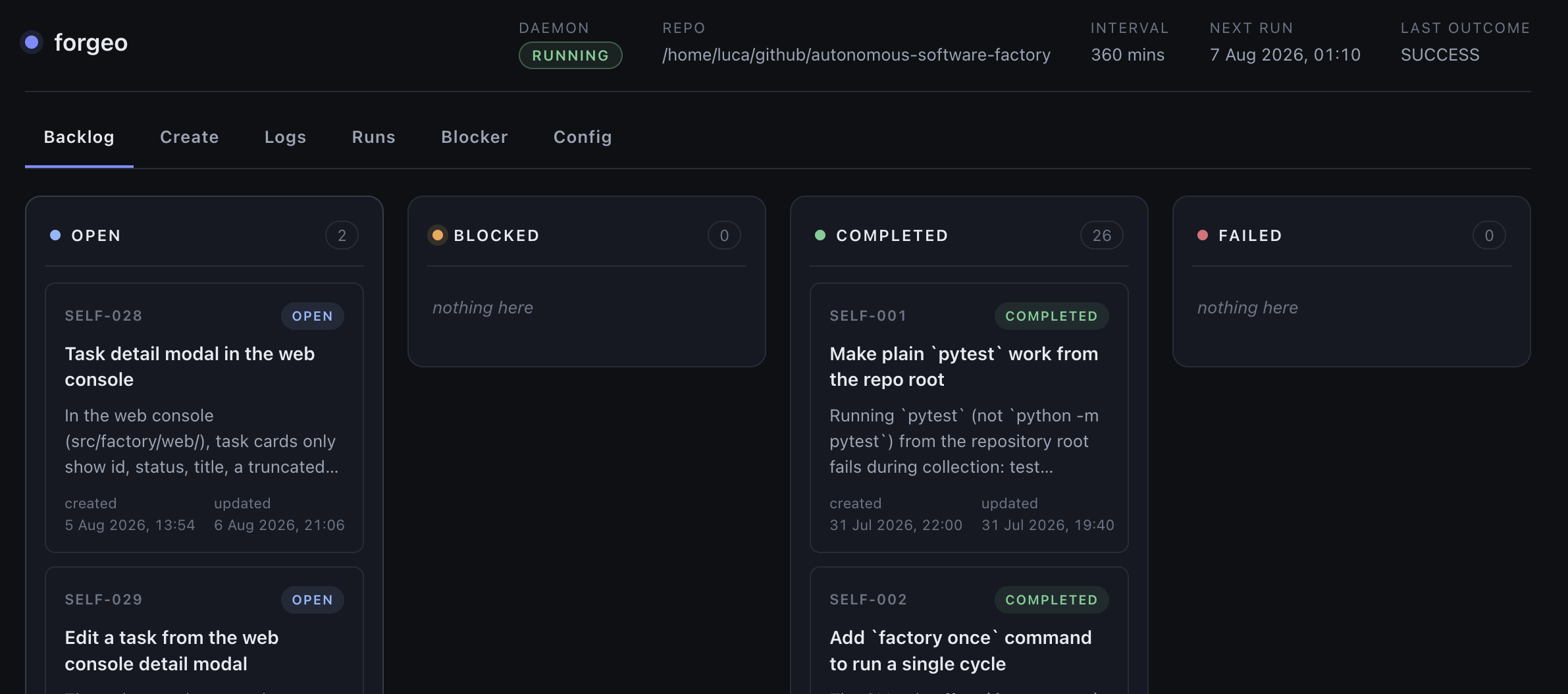
GET /— home page listing every registered instance: name, repository, daemon state (lock held), last outcome, next run, and per-status backlog counts, each linking to its instance page. For issue-backed instances (jira/github/gitlab) the card also shows an Open in Jira/GitHub/GitLab ↗ link to the native board.GET /instances/<name>/— one instance's page: a kanban backlog, a Create tab with a form to add tasks (including an optional Run at date/time input for a one-shot schedule), plus tabs for logs, history, blocker and config. For document backlogs (file/http) this board is the primary editor; for issue providers (jira/github/gitlab) it is a read-mostly mirror of the native tracker: a banner at the top links to the external board (Jira/GitHub/GitLab), each task card and its detail modal carry an Open in external ↗ link to the native issue, and the board surfaces Forgeo-specific state that the native UI does not (BLOCKED/FAILED reasons,agent_response, retry budget). Creating/editing still works via the dashboard, but triage is expected in the native tool. The header carries a DAEMON section with the daemon status tag (running/stopped) and Start/Stop/Restart buttons that callPOST /api/instances/<name>/start|stop|restart; the buttons reflect the current state (Start is disabled while running, Stop while stopped), give inline success/error feedback, and the status tag refreshes after each action and on the 30-second auto-refresh. The History tab lists recent finished cycles fromruns.jsonlin a paginated table — time, kind, task id and title, an outcome badge, duration, commit SHA and reason — newest first, with a pager once more than a page of runs exist (a friendly empty state is shown when no runs have been recorded yet). Runs that carry persisted agent output show a collapsible "agent output" row under the record: a read-only, monospace view of the bounded stdout/stderr tail (seerun_output_lines). The Config tab rendersforgeo.yamlas an editable form (interval, agent command, sandbox, telegram settings, ...): Save persists it viaPUT /api/instances/<name>/config, surfaces validation errors inline (highlighted next to the failing field), and shows a notice that the running daemon applies the change only on its next restart. Clicking a task card opens a modal with the full task details (description, acceptance criteria, dependencies, files to modify, agent command, timestamps, and the optionalrun_atone-shot schedule); it closes via the close button, the backdrop, or Escape. An Edit button switches the modal to an editable form for those fields (a Run at date/time input sets or clears the schedule); Save persists the change viaPATCHand Cancel discards it. A task whose dependencies are not allCOMPLETEDshows a Waiting on dependencies banner listing each uncompleted dependency with its current status (ormissingwhen the id does not exist in the backlog) — Forgeo will not pick the task until every dependency isCOMPLETED. ABLOCKEDtask's modal shows a highlighted banner at the top with the agent's blocker reason (the persisted per-taskblocker_reason) and how many times the task has blocked (blocked_count, e.g. "blocked 3x"); aFAILEDtask's modal shows an analogous red banner with the failure reason (the persisted per-taskfailure_reason) and the task's retry state — how many times it was retried, how many retries remain (fromretry_budget/retries_remaining), or a "retries exhausted" note when automatic retries are spent (see Backlog format). A failed task that was retried also carries a smallretried Nxbadge on its card, so you never have to open the logs to see why something failed. You can Edit aBLOCKEDtask to correct it and then Reopen it, or Reopen it as-is — Forgeo retries it on its next scheduled run.BLOCKEDtasks can also be Deleted (with confirmation), mirroring theBLOCKER.mdinstructions.
The board compacts itself so a large backlog never renders every task as a
tall card at once: once a BLOCKED/COMPLETED/FAILED column holds more
than a few tasks it collapses behind a "show …" toggle (only the OPEN
column — the actionable one — stays expanded), and every column renders at
most 20 of the most recent cards until its "show N more" button is clicked.
The header count always shows the real total, every task stays reachable by
expanding the column, and expanded/show-more state survives the 30-second
auto-refresh. This is presentation only — the task data itself is never
trimmed or reordered server-side.
Above the board, a search box and a status filter find a specific
task without scrolling. Typing filters the columns by id, title, and
description substring as you type (matching is case-insensitive), and the
status select narrows the board to a single status column. While either
filter is active every match is rendered — no "show more" or collapsed
columns — and a "no matching tasks" state is shown when nothing fits. Both
filters are reflected in the URL (?q=…&status=…) so the view survives
reloads and can be shared; they are applied entirely client-side against the
full backlog already returned by the API.
- GET /style.css, /central/central.js, /central/central.css — the
shared dark theme and dashboard scripts (no frameworks).
Endpoints
All endpoints return JSON with Content-Type: application/json and
Cache-Control: no-store. Every per-instance endpoint lives under
/api/instances/<name>/.
GET /api/instances
A JSON list of every registered instance with its repo, daemon state, last outcome, next run, and backlog counts.
curl http://127.0.0.1:8790/api/instances
Each row also carries backlog_provider (file/http/jira/github/gitlab),
backlog (path or base URL), backlog_is_issue_provider, and for issue
providers external_board_url/external_board_label (the native board link
shown on the home cards). It also carries backlog_error: null normally,
and the reason when that instance's remote backlog could not be read. Its
counts are zero in that case — the row reports a backlog it could not reach,
not an empty one. One unreachable provider never fails the whole listing.
GET /api/instances/<name>/tasks
List every task in that instance's backlog, in creation order. Each task
carries extra unsatisfied_dependencies, retry fields (see below), and for
issue providers external_url (link to the native Jira/GitHub/GitLab issue).
curl http://127.0.0.1:8790/api/instances/my-repo/tasks
[
  {
    "id": "TASK-001",
    "title": "Implement fibonacci module",
    "description": "Write a fibonacci module with memoization and tests.",
    "status": "OPEN",
    "blocker_reason": [],
    "blocked_count": 0,
    "failure_reason": [],
    "agent_response": null,
    "created_at": "2026-07-31T10:00:00Z",
    "updated_at": "2026-07-31T10:00:00Z",
    "run_at": null,
    "dependencies": [],
    "acceptance_criteria": [],
    "files_to_modify": [],
    "unsatisfied_dependencies": []
  }
]
A remote backlog is fetched on each request; when the provider is unreachable
the response is 502 with the reason in error.
GET /api/instances/<name>/tasks/{id}
Fetch a single task by id.
curl http://127.0.0.1:8790/api/instances/my-repo/tasks/TASK-001
Returns 404 with {"error": "not found"} for an unknown id.
unsatisfied_dependencies
Every task returned by GET .../tasks and GET .../tasks/{id} includes an
unsatisfied_dependencies field: a list of the task's dependencies that are
not COMPLETED, in dependencies order. Each entry has the dependency id
and its current status — or missing when no task with that id exists:
[
  { "id": "TASK-001", "status": "OPEN" },
  { "id": "TASK-003", "status": "missing" }
]
Forgeo only picks an OPEN task once every dependency is COMPLETED (see
Backlog format); the field is how the web console explains why a
task is waiting and is [] when the task has no (or only COMPLETED)
dependencies.
retry_budget and retries_remaining
Every task returned by GET .../tasks and GET .../tasks/{id} also carries
its effective automatic-retry state (when the instance's config is
available): retry_budget is the number of retries the task may have (the
per-task retries_left override falling back to the config's
failed_retry_max) and retries_remaining is max(0, retry_budget -
retry_count). The engine-managed retry_count and failed_wait_cycles
fields are part of the task object itself. The web console uses these to
show how many retries a failed task has left, or that its retries are
exhausted (see Backlog format).
POST /api/instances/<name>/tasks
Create a new task in that instance's backlog. The request body must be a JSON
object with a non-blank title and a non-blank description;
acceptance_criteria (array of strings), agent_command (string or
null, overriding the configured agent for this task) and run_at (an
ISO-8601 datetime string or null — the optional one-shot schedule: a past
value fires the task immediately, a future value keeps it unpicked until
then) are optional. The server generates the id as the next free WEB-### id
and stamps created_at/updated_at.
curl -X POST http://127.0.0.1:8790/api/instances/my-repo/tasks \
  -H 'Content-Type: application/json' \
  -d '{"title": "Implement fibonacci module", "description": "With tests.", "acceptance_criteria": ["passes pytest"], "agent_command": "claude -p \"$FORGEO_TASK\" --model claude-3-haiku", "run_at": "2026-08-20T12:30:00Z"}'
{
  "id": "WEB-001",
  "title": "Implement fibonacci module",
  "description": "With tests.",
  "status": "OPEN",
  "blocker_reason": [],
  "blocked_count": 0,
  "failure_reason": [],
  "agent_response": null,
  "created_at": "2026-08-01T12:00:00Z",
  "updated_at": "2026-08-01T12:00:00Z",
  "run_at": "2026-08-20T12:30:00Z",
  "dependencies": [],
  "acceptance_criteria": ["passes pytest"],
  "files_to_modify": []
}
Returns 201 with the created task. The write is atomic (temp file +
rename), so it is safe even while that instance's daemon is mid-cycle.
Errors:
400with{"error": "..."}— missing/blanktitle, missing/blankdescription, unparseable or non-object body, or a field of the wrong type.404with{"error": "unknown instance"}— the instance is not registered.409with{"error": "..."}— the generated id already exists in the backlog (e.g. two concurrent requests raced).
POST /api/instances/<name>/tasks/{id}/reopen
Reopen a BLOCKED task so Forgeo retries it on its next scheduled run: its
status is set back to OPEN, blocker_reason is cleared, and blocked_count
is kept as history. No request body is required. A dedicated endpoint rather
than a generic status via PATCH — status transitions stay outside the
editable-fields model.
curl -X POST http://127.0.0.1:8790/api/instances/my-repo/tasks/TASK-001/reopen
{
  "id": "TASK-001",
  "title": "Implement fibonacci module",
  "description": "Write a fibonacci module with memoization and tests.",
  "status": "OPEN",
  "blocker_reason": [],
  "blocked_count": 1,
  "failure_reason": [],
  "agent_response": null,
  "created_at": "2026-07-31T10:00:00Z",
  "updated_at": "2026-08-01T12:00:00Z",
  "dependencies": [],
  "acceptance_criteria": [],
  "files_to_modify": []
}
Returns 200 with the reopened task. The write is atomic (temp file +
rename), so it is safe even while that instance's daemon is mid-cycle. Once
the last BLOCKED task is resolved, the derived BLOCKER.md disappears on
the next cycle automatically. Errors:
400with{"error": "only BLOCKED tasks can be reopened"}— the task exists but is notBLOCKED(it is untouched).404with{"error": "not found"}— the task id does not exist in that instance's backlog.404with{"error": "unknown instance"}— the instance is not registered.
PATCH /api/instances/<name>/tasks/{id}
Update an existing task's editable fields: title, description,
acceptance_criteria, dependencies, files_to_modify, agent_command,
agent_timeout_seconds, retries_left (the per-task automatic-retry
budget override; a non-negative integer or null), and run_at (the
optional one-shot schedule; an ISO-8601 datetime string or null to clear
it). The request body is a JSON object; omitted fields are left unchanged
and id, status, blocker_reason, blocked_count, failure_reason,
agent_response, retry_count, failed_wait_cycles, and created_at are
always preserved (they are engine-managed — PATCH rejects them like it
rejects status).
agent_command may be a string, an array, or null (clear the per-task
override); agent_timeout_seconds may be a positive number or null.
updated_at is bumped to the current time.
curl -X PATCH http://127.0.0.1:8790/api/instances/my-repo/tasks/TASK-001 \
  -H 'Content-Type: application/json' \
  -d '{"description": "Write a fibonacci module with tests.", "agent_timeout_seconds": 120, "run_at": "2026-08-20T12:30:00Z"}'
{
  "id": "TASK-001",
  "title": "Implement fibonacci module",
  "description": "Write a fibonacci module with tests.",
  "status": "OPEN",
  "blocker_reason": [],
  "blocked_count": 0,
  "failure_reason": [],
  "agent_response": null,
  "created_at": "2026-07-31T10:00:00Z",
  "updated_at": "2026-08-01T12:00:00Z",
  "dependencies": [],
  "acceptance_criteria": [],
  "files_to_modify": []
}
Returns 200 with the updated task. The write is atomic (temp file +
rename), so it is safe even while that instance's daemon is mid-cycle.
Errors:
400with{"error": "..."}— unparseable or non-object body, an empty body, an unknown field (e.g.status,blocker_reason,blocked_count,failure_reason,agent_response), or an invalid value (blanktitle, wrong field types, a non-positiveagent_timeout_seconds).404with{"error": "not found"}— the task id does not exist in that instance's backlog.404with{"error": "unknown instance"}— the instance is not registered.
DELETE /api/instances/<name>/tasks/{id}
Delete an OPEN or BLOCKED task from that instance's backlog (e.g. a task
added by mistake, or a BLOCKED task the human decides should not be done —
per the BLOCKER.md instructions). COMPLETED and FAILED tasks stay in the
record.
curl -X DELETE http://127.0.0.1:8790/api/instances/my-repo/tasks/TASK-001
Returns 200 with the deleted task. The write is atomic (temp file +
rename), so it is safe even while that instance's daemon is mid-cycle.
Errors:
400with{"error": "only OPEN or BLOCKED tasks can be deleted"}— the task exists but isCOMPLETEDorFAILED(it is untouched).404with{"error": "not found"}— the task id does not exist in that instance's backlog.404with{"error": "unknown instance"}— the instance is not registered.
GET /api/instances/<name>/status
Daemon status: name, repo, interval, daemon_running (whether the instance's
lock is held), the recorded PID, last_outcome, and the next_run_at. Also
carries backlog_provider, backlog, backlog_is_issue_provider,
external_board_url/external_board_label so the instance page can render the
issue-provider banner and per-task external links.
curl http://127.0.0.1:8790/api/instances/my-repo/status
{
  "name": "my-repo",
  "repo": "/home/me/projects/site-a",
  "interval_minutes": 30,
  "daemon_running": true,
  "pid": 4242,
  "last_outcome": "task",
  "next_run_at": "2026-08-01T12:00:00+00:00",
  "backlog_provider": "github",
  "backlog": "https://api.github.com",
  "backlog_is_issue_provider": true,
  "external_board_url": "https://github.com/owner/repo/issues",
  "external_board_label": "GitHub"
}
pid, last_outcome and next_run_at come from the daemon's
daemon.state.json (written after every cycle). When no state file exists,
last_outcome falls back to runs.jsonl and next_run_at to an estimate
(the last run's finish plus the interval) — only while the daemon is running.
next_run_at is null when the daemon is not running.
GET /api/instances/<name>/config
The resolved forgeo.yaml as JSON.
curl http://127.0.0.1:8790/api/instances/my-repo/config
PUT /api/instances/<name>/config
Validate and persist an instance's forgeo.yaml. The request body is the same
shape GET /api/instances/<name>/config returns, and is validated against the
same ForgeoConfig schema the daemon uses. Relative paths (repo, backlog,
blocker_file, log_file) are stored relative to the config file's own
directory, so they resolve to the same absolute paths on the daemon's next
load — sending back the exact payload from GET round-trips the file without
hard-coding absolute paths into it.
curl -X PUT http://127.0.0.1:8790/api/instances/my-repo/config \
  -H 'Content-Type: application/json' \
  -d '{"name": "my-repo", "repo": "/home/me/projects/site-a", "interval_minutes": 60, "backlog": "backlog.json", "blocker_file": "BLOCKER.md", "agent_command": "claude -p \"$FORGEO_TASK\" --model haiku", "log_file": "forgeo.log"}'
The write is atomic (temp file + rename), like the other write endpoints.
Returns 200 with the reloaded config plus a note on when it takes effect:
{
  "saved": true,
  "restart_required": false,
  "message": "Config saved. The daemon picks up changes on its next cycle.",
  "config": { "...": "the reloaded config, paths resolved" }
}
The daemon watches forgeo.yaml and picks the change up on its next cycle
(SIGHUP wakes it sooner), so a config save needs no restart; restart_required
is false on every successful save. Path changes (repo, backlog,
blocker_file, log_file) are pinned to the daemon's startup paths and need
a restart (via the Restart button or POST .../restart). Errors:
400with{"error": "..."}— an unparseable, non-object or empty body; a payload that failsForgeoConfigvalidation (e.g. a blankagent_command, a non-positiveinterval_minutes, adockeragent_sandboxwithout anagent_sandbox_image); anamethat differs from the registered instance name; or an attempt to changetelegram_bot_token.404with{"error": "unknown instance"}— the instance is not registered.500with{"error": "instance config not available"}— the instance's config cannot currently be loaded.
name is owned by the registry (it is the key mapping an instance to its
forgeo.yaml) and is forced to the registered name — sending a different value
is rejected. telegram_bot_token is not editable through the web console: an
explicit change is rejected with 400, and the current value is preserved when
the field is omitted, so a partial payload never wipes it. backlog_auth,
state_dir and task_context are likewise preserved when the payload omits
them — a save must not drop what it never showed (the console renders
task_context as a plain text field; the other two are nested settings it
does not render). Everything else GET .../config returns (including
agent_env, which can carry credentials the agent needs) is editable.
POST /api/instances/<name>/start, /stop, /restart
Start, stop, or restart that instance's daemon — the same lifecycle as
forgeo start/forgeo stop/forgeo restart, exposed to the web console as
an explicit operator action. This is how a config saved from the Config
tab that moves paths is applied: the daemon re-reads forgeo.yaml on every
start, so a restart picks up the saved settings (a plain config edit is
picked up on the next cycle without one). No request body is required.
start— launch a detachedforgeo startfor the instance (the same background daemonforgeo startlaunches). Refused with409when the daemon is already running.stop— SIGTERM the running daemon and wait for it to exit. A cycle in progress always finishes first, so partial work is never lost. When the daemon is not running this is a200no-op reportingnot_running.restart— stop the daemon when running (waiting for any cycle in progress), then start it detached; when it wasn't running it just starts it.
Every endpoint returns the outcome and the post-action daemon state:
curl -X POST http://127.0.0.1:8790/api/instances/my-repo/start
{
  "status": "started",
  "message": "Forgeo 'my-repo' started (pid 4242, interval 30 min).",
  "daemon_running": true,
  "pid": 4242
}
status is one of started, already_running, stopped, not_running,
restarted, start_failed, stop_failed, restart_failed; daemon_running
is the lock state after the action. Errors:
409with{"error": "daemon already running", "status": "already_running"}—startwhile the daemon holds the lock (the UI disables Start while running, so this is an edge case).404with{"error": "unknown instance"}— the instance is not registered.500with{"error": "instance config not available"}— the instance's config cannot currently be loaded.500with{"error": "..."}— the stop or start failed: the recorded PID is gone but the lock is still held, the daemon did not start within the startup timeout, or it is still shutting down when the stop timeout elapses.
GET /api/instances/<name>/logs?lines=N
The last N lines of that instance's forgeo.log (N defaults to 100,
max 10000).
curl http://127.0.0.1:8790/api/instances/my-repo/logs
curl "http://127.0.0.1:8790/api/instances/my-repo/logs?lines=50"
GET /api/instances/<name>/runs?limit=N&offset=M
That instance's durable run history from runs.jsonl, newest first and
paginated. limit defaults to 10 (max 10000); offset defaults to 0
and skips that many of the newest records, so the web console's History
tab pages through old runs. The response is an object: runs holds the
requested page, total is the number of readable records (for pager
controls), and limit/offset echo the request. Each record has
started/finished timestamps, the run kind (task or refactor), the task id
and title when applicable, the outcome (SUCCESS / BLOCKED / ERROR), the
agent exit code, the commit SHA when a commit was created, the duration in
seconds, an optional reason when the run completed without a commit (a
no-change SUCCESS is surfaced here instead of silently showing a null commit
SHA), and output_logs: the bounded tail of the agent's stdout/stderr for
that run (at most run_output_lines lines) or null for runs that never
reached the agent or that predate the field. When the run was a retry of a
previously failed task, retry_count carries how many times the task had
already been retried (task runs only; null otherwise), so the History tab
can show which runs were retries. The web console renders the output tail in
a read-only, collapsible view in the History tab. A missing or empty
runs.jsonl yields runs: [] with total: 0.
curl http://127.0.0.1:8790/api/instances/my-repo/runs
curl "http://127.0.0.1:8790/api/instances/my-repo/runs?limit=5"
curl "http://127.0.0.1:8790/api/instances/my-repo/runs?limit=25&offset=25"
{
  "runs": [
    {
      "started_at": "2026-08-01T11:55:00Z",
      "finished_at": "2026-08-01T12:00:10Z",
      "kind": "task",
      "task_id": "TASK-001",
      "task_title": "Implement fibonacci module",
      "outcome": "SUCCESS",
      "agent_exit_code": 0,
      "commit_sha": "a1b2c3d4e5f6",
      "duration_seconds": 310.2,
      "reason": null,
      "output_logs": [
        "[stdout] Creating module fibonacci.py",
        "[stdout] Running tests: 12 passed, 0 failed",
        "[shell] Task TASK-001 finished successfully (exit 0)."
      ]
    }
  ],
  "total": 1,
  "offset": 0,
  "limit": 10
}
GET /api/instances/<name>/blocker
The instance's BLOCKER.md contents, or {"content": null} when none
exists.
curl http://127.0.0.1:8790/api/instances/my-repo/blocker
Behavior
- An unknown instance name returns
404({"error": "unknown instance"}). - A registered instance with missing data files renders with empty data and
daemon_running=falseinstead of erroring — the instance page and every API endpoint still return200. - The write endpoints are
POST /api/instances/<name>/tasks(append a task),POST /api/instances/<name>/tasks/<id>/reopen(reopen aBLOCKEDtask),POST /api/instances/<name>/start|stop|restart(daemon lifecycle),PATCH /api/instances/<name>/tasks/<id>(update a task's editable fields),DELETE /api/instances/<name>/tasks/<id>(delete anOPENorBLOCKEDtask), andPUT /api/instances/<name>/config(validate and persist the instance'sforgeo.yaml; applies on the daemon's next cycle).
Errors
400— malformedPOST/PATCH/PUTbody (missing/blank title, unparseable body, wrong field types, unknown fields), a config payload that fails schema validation, a change to an instance's registerednameor to itstelegram_bot_token, aPOST reopenof a task that is notBLOCKED, orDELETEof a task that is neitherOPENnorBLOCKED.404— unknown API path, unknown instance, unknown task, or missing static file.409—POSTid collision (a concurrent request won the race), or aPOST startwhile the instance's daemon is already running.500— an unexpected handler error (logged server-side), a daemon lifecycle action whose stop or start failed, or an instance whose config cannot currently be loaded.
Example: a status one-liner
curl -s http://127.0.0.1:8790/api/instances/my-repo/status
Security notes
- The dashboard binds
0.0.0.0by default so every forgeo on the host is visible from your LAN. Exposing it publicly (--host 0.0.0.0on a public interface) makes every instance's backlog, logs, and config visible to every host that can reach the port — only do that on a trusted network. - Bearer-token auth (see Authentication)
closes the API to anonymous clients: every
/api/*route — read and write — requiresAuthorization: Bearer <token>and returns401otherwise, while static pages and the token prompt stay public. It does not add transport encryption: put the dashboard behind a TLS proxy (or an SSH tunnel) when you use the token over the network, so the token is not sent in cleartext. The?token=...URL convenience form puts the token in the address bar and server logs — prefer pasting it on the prompt page. - The write endpoints are
POST /api/instances/<name>/tasksandPATCH /api/instances/<name>/tasks/<id>(andPOST /api/instances/<name>/tasks/<id>/reopento retry aBLOCKEDtask, plusDELETE /api/instances/<name>/tasks/<id>for open or blocked tasks,POST /api/instances/<name>/start|stop|restartto start/stop/restart that instance's daemon, andPUT /api/instances/<name>/configfor an instance's configuration). A machine that can reach the port can add tasks to any instance's queue, edit their fields, retry blocked ones, delete open or blocked ones, start, stop and restart that instance's daemon, and change an instance's configuration (interval, agent command, paths, ...). The config write cannot change an instance's registerednameor itstelegram_bot_token, and it never restarts a daemon — the new config applies on the daemon's next cycle, except path changes (repo,backlog,blocker_file,log_file) which need a restart (via the Restart button orPOST .../restart).